The International Journal of Artificial Intelligence, Quantum Computing & Cyber Security (IJAQC Online) is an international, peer-reviewed, open-access scholarly journal dedicated to publishing high-quality, original, and innovative research in the fields of Artificial Intelligence (AI), Quantum Computing, Cyber Security, Computer Science, Information Technology, Data Science, Machine Learning, Deep Learning, Blockchain, Internet of Things (IoT), Cloud Computing, Robotics, Natural Language Processing (NLP), Computer Vision, and other emerging technologies.
IJAQC (Online) provides a global platform for researchers, academicians, scientists, engineers, industry professionals, policymakers, and research scholars to disseminate cutting-edge research, exchange innovative ideas, and promote interdisciplinary collaboration in rapidly evolving technological domains.
The journal publishes original research articles, review papers, systematic literature reviews, case studies, technical notes, conceptual papers, and short communications that significantly contribute to scientific knowledge, technological innovation, and practical applications. Every submitted manuscript undergoes a rigorous Double-Blind Peer Review process to ensure originality, scientific quality, technical excellence, and ethical integrity.
The journal encourages multidisciplinary and interdisciplinary research that bridges academia, industry, government, and society by addressing current challenges and future opportunities in intelligent computing, secure digital systems, and next-generation technologies.
The International Journal of Artificial Intelligence, Quantum Computing & Cyber Security (IJAQC Online) aims to:
Publish high-quality, original, and impactful research in Artificial Intelligence, Quantum Computing, Cyber Security, and emerging technologies.
Promote innovation and interdisciplinary scientific research.
Provide an international platform for researchers, academicians, industry experts, and policymakers.
Encourage collaboration between academia, industry, and government organizations.
Support the development of intelligent, secure, and sustainable technological solutions.
Advance scientific knowledge through ethical, transparent, and rigorous scholarly publishing
Read More
Dear Esteemed Researchers,
Knowledge grows when it is shared. We are delighted to invite authors from around the world to publish their original research in IJAQC (Online) & IJRM. Our journals provide an international platform for the dissemination of high-quality, peer-reviewed research that contributes to academic excellence and practical innovation.
We uphold the highest standards of publication ethics, transparency, and scholarly integrity. Every manuscript is evaluated through a rigorous double-blind peer review process to ensure originality, quality, and relevance.
We sincerely welcome your contributions and look forward to collaborating with you in advancing global research.
With Best Regards,
Prof(Dr) Shankar Lal Gupta
Chief-Editor
International Journal of Artificial Intelligence, Quantum Computing and Cyber Security (IJAQC Online)
International Journal of Retailing and Marketing (IJRM)
Email Id - radianteducationtrust@gmail.com & drslgupta@gmail.com
Phone no - +91-8796278474

Prof (Dr) S.L. Gupta
Former Professor and Former Director,
Birla Institute of Technology, Noida
Founder & Chairman - Radiant Education Trust

Dr. Lee Chu Keong
Programme Director, Master of Science (Knowledge Management) Programme
Nanyang Technological University, Singapore
Email: ascklee@ntu.edu.sg
Read More
Dr Bezverkhyi Kostiantyn,
Doctor of Sciences in Economics, associate professor, Professor of the Department of Аccounting and Consulting
Kyiv National Economic University named after Vadym Hetman (Ukraine, Kyiv)
Email: kosticbv@ukr.net
Read MoreDear Professor/Researcher/Academician,
Greetings from Radiant Education Trust (RET)!
We are pleased to invite researchers, academicians, faculty members, industry professionals, scientists, and research scholars to submit their original and unpublished research papers for publication in the inaugural issue of the International Journal of Artificial Intelligence, Quantum Computing and Cyber Security (IJAQC Online).
Volume 1 | Issue 1 | September 2026
IJAQC (Online) is a peer-reviewed, open-access international journal dedicated to publishing high-quality research in Artificial Intelligence, Quantum Computing, Cyber Security, Data Science, Intelligent Systems, and emerging digital technologies. Every accepted paper will receive a DOI (Digital Object Identifier) through Crossref in accordance with applicable UGC guidelines.
The journal is committed to maintaining the highest standards of scholarly publishing. As the journal grows and fulfills eligibility requirements, applications will be made for indexing in leading international databases including Scopus, Web of Science, DOAJ, EBSCO, ProQuest, Google Scholar, Dimensions, and other recognised indexing services.
We welcome original and unpublished manuscripts in, but not limited to:
Artificial Intelligence
Machine Learning & Deep Learning
Natural Language Processing (NLP)
Computer Vision
Quantum Computing
Quantum Machine Learning
Cyber Security & Digital Forensics
Data Science & Analytics
Blockchain & Web3
Robotics & Intelligent Systems
Edge Computing, IoT & Digital Twins
Green Computing
Smart Cities & Industry 4.0
Healthcare, Education, FinTech, Agriculture, Transportation and other interdisciplinary applications.
Rigorous Double-Blind Peer Review
Open Access Journal
DOI for Every Published Article
Rapid Editorial & Publication Process
Global Visibility & Wider Dissemination
Indexing in Leading National & International Databases (as applicable)
Call for Papers Opens: 05 July 2026
Submission Deadline: 31 July 2026
Acceptance Notification: 15 August 2026
Final Manuscript Submission: 31 August 2026
Online Publication: September 2026
There will be no Article Processing Charge (APC) for the first two issues.
Authors are encouraged to follow COPE, ICMJE and DOAJ best practices.
Author Contribution (CRediT), Funding Statement, Conflict of Interest, Data Availability Statement and AI Disclosure Policy will be applicable.
Email: radianteducationtrust@gmail.com
Mobile: +91 87962 78474
We encourage you to contribute your innovative research and become part of this prestigious international publication.
Please circulate this Call for Papers among your colleagues, faculty members, research scholars and academic network.
Thank you, and we look forward to receiving your valuable contribution.
Prof. (Dr.) Shankar Lal Gupta
Former Professor, Marketing & Finance
Former Director, Birla Institute of Technology, Mesra - Noida Campus
Warm Regards,
International Journal of Artificial Intelligence, Quantum Computing & Cyber Security (IJAQC Online)
Radiant Education Trust (RET)
The method used to determine the content of a manuscript before it is published online is the peer review process. Independent professionals/experts/researchers in the related research sector are expected to evaluate the uniqueness, validity and relevance of the submitted manuscripts to assist editors in deciding whether a manuscript should be published in their journal
This process of peer review helps validate the research work, create a method by which it can be assessed and expand the possibilities of networking within research communities. Despite criticism, peer review is still the most generally accepted means of validating science
Only papers submitted with bibliographic reasoning that follow good scientific criteria, explanations, records and proof of their work (e.g. understanding and building on other work in the field, relying on rational reasoning and well-designed experiments, supporting statements with evidence, etc.) are approved for publication in the Journal.
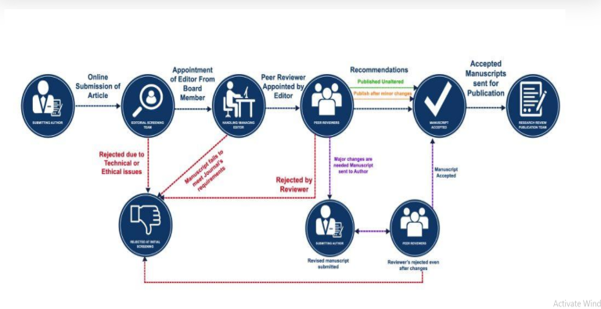
We usually follow the method of double-blind peer review, in which both the authors and the editors who will review the submitted papers and authorize them for publication are unaware of the identity of each other.
The editor of the journal assigns the papers obtained from the researchers to the reviewers in this process, in which the reviewers are initially expected to check the scope of the manuscript, whether it suits the journal or not, to provide their comments or any suggestions/edits in the paper (if necessary) to accept the manuscript for publication in the journal.
This constitutes the basis for determining if the work should be approved, revised as acceptable, or rejected. Submissions with significant shortcomings would be rejected, but after they have been thoroughly revised, they can be re-submitted.
This does not necessarily mean it is of low quality if a job is refused. A paper can also be rejected because it does not fall within the specialis ation field of the journal or because it does not meet the high expectations of innovation and originality that the journal in question demands.
If the reviewer recommends only minor edits, the journal will publish the article, but the author is asked to make certain corrections before that.
The International Journal of Artificial Intelligence, Quantum Computing & Cyber Security (IJAQC Online) sincerely appreciates the valuable contribution of its reviewers in maintaining the quality, integrity, and credibility of scholarly publishing. Peer reviewers play a vital role in ensuring that only scientifically sound, original, and ethically conducted research is published.
The journal follows a Double-Blind Peer Review process in which the identities of both authors and reviewers remain confidential throughout the review process.
Assess the originality and novelty of the research.
Evaluate the scientific and technical quality of the manuscript.
Verify the validity of the methodology and results.
Ensure ethical compliance and academic integrity.
Improve manuscript quality through constructive feedback.
Assist editors in making fair publication decisions.
Review manuscripts objectively, fairly, and professionally.
Maintain complete confidentiality.
Accept reviews only within their area of expertise.
Complete reviews within the stipulated review period.
Provide constructive comments supported by academic evidence.
Identify strengths, weaknesses, and improvements.
Declare any conflicts of interest.
Report plagiarism, duplicate publication, AI misuse, or research misconduct.
Do not share manuscripts with third parties.
Do not discuss unpublished research.
Do not use unpublished information for personal or professional benefit.
Do not contact the authors directly.
Maintain confidentiality even after review completion.
Reviewers should decline the review invitation if they have:
Personal relationships with authors.
Institutional affiliation with authors.
Financial interests.
Collaborative research relationships.
Professional rivalry or competition.
Any circumstance affecting impartial judgement.
Plagiarism
Self-plagiarism
Duplicate publication
Data fabrication or falsification
Image manipulation
Citation manipulation
Ethical violations
Unauthorized AI-generated content
Copyright infringement
Novel contribution to knowledge.
Falls within the scope of IJAQC (Online).
Scientifically sound methodology.
Appropriate algorithms and experimental procedures.
Current and comprehensive references.
Appropriate research design.
Adequate datasets and methods.
Accurate presentation of findings.
Appropriate figures, tables and analyses.
Correct interpretation and discussion of limitations.
Supported by research findings.
Accurate, relevant and up-to-date citations.
Clear, professional English.
Accept without Revision
Minor Revision
Major Revision
Reject
Be objective and respectful.
Focus on improving the manuscript.
Avoid personal criticism.
Provide evidence-based suggestions.
Respond promptly to invitations.
Complete reviews within deadlines.
Inform the Editorial Office if more time is needed.
Do not upload confidential manuscripts to public AI tools.
AI may only assist with language support.
Reviewers remain fully responsible for their review.
Reviewer Certificate
Annual Certificate of Appreciation
Outstanding Reviewer Award
Recognition on the journal website (with consent)
Opportunity to join the Editorial Board
Priority consideration for future editorial responsibilities
Reviewer recommendations are advisory. The final decision regarding acceptance, revision, or rejection rests solely with the Editor-in-Chief, based on reviewer reports, editorial evaluation, and journal policies.
Integrity
Fairness
Objectivity
Confidentiality
Professionalism
Transparency
Accountability
Respect for Intellectual Property
Academic Excellence
The International Journal of Artificial Intelligence, Quantum Computing & Cyber Security (IJAQC Online) is committed to maintaining an ethical, transparent, and internationally recognised peer-review system. Through the dedication of qualified reviewers, the journal strives to publish high-quality, impactful, and innovative research that advances Artificial Intelligence, Quantum Computing, Cyber Security, Computer Science, Information Technology, Data Science, Machine Learning, Blockchain, Cloud Computing, Robotics, and other emerging technologies.
The Editorial Board sincerely thanks all reviewers for their valuable time, expertise, and commitment to maintaining the highest standards of scholarly publishing.
Every manuscript is evaluated for:
Relevance to the journal scope.
Originality and novelty.
Scientific significance.
Compliance with submission guidelines.
Language quality.
Ethical compliance.
Plagiarism screening.
Suitable manuscripts are assigned to an Associate Editor who appoints independent expert reviewers based on subject expertise.
Minimum two independent reviewers.
Authors remain anonymous.
Reviewers remain anonymous.
Evaluation based solely on academic merit.
Originality and innovation.
Scientific contribution.
Relevance to the journal scope.
Research methodology.
Experimental design.
Accuracy of results.
Practical applications.
Quality of writing.
References and citations.
Ethical compliance.
Accept without revision.
Accept with minor revisions.
Major revisions required.
Reject manuscript.
Authors should submit:
Revised manuscript.
Point-by-point response to reviewers.
Document highlighting revisions.
The Editor-in-Chief makes the final decision regarding acceptance, revision or rejection after considering reviewer reports.
| Stage | Expected Time |
|---|---|
| Initial Editorial Screening | 5-7 Working Days |
| Double-Blind Peer Review | 2-4 Weeks |
| Author Revision | 1-3 Weeks |
| Final Editorial Decision | 5-10 Working Days |
| Online Publication | Within 7 Days |
Conduct fair and objective reviews.
Maintain confidentiality.
Review only within their expertise.
Meet review deadlines.
Declare conflicts of interest.
Report ethical concerns.
Editors and reviewers shall treat all submitted manuscripts as confidential documents and use them solely for scholarly evaluation.
Editors and reviewers must disclose financial, institutional or personal conflicts that could influence editorial decisions.
Fairness
Transparency
Confidentiality
Objectivity
Academic Integrity
Professional Responsibility
IJAQC (Online) is dedicated to maintaining a transparent, ethical and internationally recognised peer-review system that promotes scientific excellence, technological innovation and high-quality scholarly publishing.
The International Journal of Artificial Intelligence, Quantum Computing & Cyber Security (IJAQC Online) is committed to Open Access publishing, ensuring that high-quality scholarly research is freely available to researchers, academicians, scientists, industry professionals, policymakers, students, and the global research community.
All published articles are immediately available online without subscription, registration, or access fees. Readers may read, download, print, copy, distribute, search, and cite published articles for lawful academic and educational purposes with proper attribution.
Promote unrestricted dissemination of scientific knowledge.
Increase visibility and impact of published research.
Encourage interdisciplinary collaboration.
Support innovation in AI, Quantum Computing and Cyber Security.
Promote knowledge sharing for academia, industry and society.
Immediate worldwide accessibility.
Greater visibility and discoverability.
Higher readership and citation potential.
Rapid dissemination of research findings.
Enhanced academic collaboration.
Long-term digital preservation.
Authors retain copyright while granting the journal a non-exclusive licence to publish, archive, index and disseminate their work.
Share articles on personal and institutional websites.
Deposit articles in repositories and databases.
Use published work for teaching and research.
Reuse content in future publications with proper citation.
Read and download articles free of charge.
Print articles for educational purposes.
Cite published work appropriately.
Share article links.
Use content for research and non-commercial education.
IJAQC (Online) follows the Gold Open Access publishing model. Accepted articles are published online immediately without any embargo period.
Articles are distributed under the journal's applicable licensing policy. Users must provide proper attribution whenever published work is reused.
Published articles are digitally archived to ensure long-term preservation, integrity and permanent accessibility.
Research is disseminated through scholarly databases, indexing services, search engines and recognised academic repositories.
IJAQC (Online) supports transparency, reproducibility and responsible sharing of scientific knowledge across Artificial Intelligence, Quantum Computing, Cyber Security and emerging technologies.
IJAQC (Online) is committed to ethical, transparent and unrestricted scholarly communication while promoting scientific innovation and global knowledge exchange.
The International Journal of Artificial Intelligence, Quantum Computing & Cyber Security (IJAQC Online) is committed to maintaining the highest standards of publication ethics, research integrity, transparency, and professional conduct. The journal expects all participants involved in the publication process—including authors, editors, reviewers, editorial board members, and the publisher—to adhere to internationally accepted ethical standards.
IJAQC (Online) follows the ethical principles and best practices recommended by the Committee on Publication Ethics (COPE) and promotes honesty, originality, accountability, fairness, transparency, and academic integrity throughout the publication process.
The Editor-in-Chief and Editorial Board shall:
Evaluate manuscripts solely on academic merit, originality, scientific quality, technical contribution, and relevance.
Make editorial decisions without discrimination.
Ensure a fair, confidential, and timely Double-Blind Peer Review process.
Maintain confidentiality of manuscripts and reviewer identities.
Select qualified reviewers with appropriate expertise.
Investigate plagiarism, duplicate publication, data fabrication, falsification, image manipulation, and other misconduct.
Avoid conflicts of interest.
Publish corrections, retractions, or clarifications when necessary.
Maintain editorial independence from commercial or financial interests.
Authors submitting manuscripts to IJAQC (Online) shall:
Submit only original and unpublished work.
Ensure all data, software, algorithms, and findings are accurate.
Properly acknowledge all sources and citations.
Avoid plagiarism, duplicate publication, and data manipulation.
Include only genuine contributors as authors.
Nominate one corresponding author.
Disclose funding sources and conflicts of interest.
Obtain ethical approvals where required.
Notify the journal promptly if significant errors are discovered.
Retain original research data when requested.
Authorship shall be limited to individuals making significant intellectual contributions such as:
Research conception and design.
Algorithm or model development.
Data collection or acquisition.
Software development.
Data analysis and interpretation.
Manuscript drafting or revision.
Final approval before submission.
Individuals providing only technical, financial, or language support should be acknowledged but not listed as authors.
Reviewers shall:
Conduct objective and unbiased reviews.
Maintain strict confidentiality.
Review only within their expertise.
Complete reviews within agreed timelines.
Identify relevant missing references.
Report plagiarism or ethical concerns.
Declare conflicts of interest.
Avoid using confidential information for personal benefit.
The Publisher is committed to:
Preserving editorial independence.
Supporting transparent editorial and peer review.
Protecting authors' intellectual property.
Maintaining integrity and accessibility of published content.
Preserving digital archives.
Cooperating in investigations of publication misconduct.
Publishing corrections and retractions where necessary.
IJAQC (Online) considers the following as serious ethical violations:
Plagiarism.
Data fabrication.
Data falsification.
Image manipulation.
Citation manipulation.
Duplicate submission.
Redundant publication.
Undisclosed conflicts of interest.
Manipulation of AI-generated research outputs.
Such misconduct may result in rejection, correction, retraction, or institutional notification.
Where applicable, authors shall confirm:
Ethics committee approval.
Informed consent from participants.
Compliance with privacy laws.
Responsible handling of security-sensitive research.
All authors, reviewers, editors, and editorial board members shall disclose any financial, professional, institutional, or personal relationships that may influence the publication process. Appropriate measures will be taken to ensure independent editorial decisions.
Where misconduct is confirmed, the journal may:
Reject the manuscript.
Request corrections.
Publish a corrigendum or retraction.
Notify the author's institution or funding agency.
Suspend future submissions.
Inform relevant academic or professional bodies.
The International Journal of Artificial Intelligence, Quantum Computing & Cyber Security (IJAQC Online) is dedicated to fostering honesty, transparency, fairness, accountability, and scientific excellence. By adhering to internationally recognized publication ethics, the journal seeks to ensure the credibility, reliability, and long-term value of the scholarly work it publishes while advancing knowledge in Artificial Intelligence, Quantum Computing, Cyber Security, Computer Science, Information Technology, Data Science, Machine Learning, Blockchain, Cloud Computing, Robotics, and other emerging technologies.
International Journal of Artificial Intelligence, Quantum Computing & Cyber Security (IJAQC Online)
The International Journal of Artificial Intelligence, Quantum Computing & Cyber Security (IJAQC Online) is committed to maintaining the accuracy, integrity, transparency, and reliability of the scholarly record. Despite rigorous editorial screening and peer review, errors may occasionally be identified after publication. When such errors are brought to the attention of the Editorial Office, the journal will take appropriate corrective action in a fair, transparent, and timely manner.
Corrections are made only when the identified error materially affects the accuracy, interpretation, reproducibility, scientific validity, or integrity of the published work. Minor typographical or formatting errors that do not influence the scientific content generally do not require formal correction.
The purpose of the Article Correction Policy is to:
Preserve the integrity and credibility of the scholarly record.
Correct significant scientific, technical, or editorial errors.
Ensure transparency in scholarly communication.
Maintain the confidence of authors, reviewers, readers, and indexing agencies.
Protect the reputation of the journal and its published research.
An Erratum is issued when a significant error has been introduced by the journal during the editorial or production process.
Examples include:
Incorrect author names or affiliations.
Errors in the article title or abstract.
Incorrect figures, tables, equations, or algorithms introduced during production.
Missing acknowledgements or funding information due to editorial oversight.
Production or formatting errors affecting interpretation of the published work.
All errata will be published promptly and permanently linked to the original article.
A Corrigendum is issued when authors identify a significant error in their published article that affects the accuracy or clarity of the research but does not invalidate its overall findings.
Examples include:
Errors in datasets or numerical values.
Incorrect equations, algorithms, or computational models.
Mistakes in references or citations.
Errors in software implementation or methodological descriptions.
Incorrect figures, graphs, tables, or supplementary materials prepared by the authors.
All authors must approve the corrigendum before publication.
An Addendum provides additional peer-reviewed information that enhances or clarifies a published article without altering its original conclusions.
Examples include:
Additional experimental or computational results.
Clarification requested by readers or reviewers.
Supplementary datasets or software documentation.
Additional technical explanations omitted unintentionally during submission.
Addenda are subject to editorial evaluation and, where appropriate, independent peer review.
A Retraction is issued when a published article is found to contain serious ethical, scientific, or technical problems that render its findings unreliable.
Retraction may occur in cases involving:
Plagiarism.
Data fabrication or falsification.
Image manipulation.
Fraudulent or manipulated research results.
Duplicate or redundant publication.
Serious methodological or computational errors.
Unethical research practices.
Copyright infringement.
Manipulation of the peer review process.
Unauthorized or malicious use of Artificial Intelligence in generating research results.
Retraction notices will remain permanently linked to the original article to preserve the integrity of the scholarly record.
The Editor-in-Chief may publish an Expression of Concern when credible evidence suggests possible research misconduct or significant concerns regarding a published article, but the investigation has not yet been completed.
Following the investigation, the journal may publish:
A correction.
A corrigendum.
A retraction.
A notice confirming that no further action is necessary.
Authors requesting a correction should submit:
A formal written request to the Editorial Office.
Article title, DOI (if assigned), volume, issue, and publication details.
A detailed explanation of the identified error.
The corrected text, figures, tables, algorithms, datasets, or other relevant material.
Supporting evidence where applicable.
The Editorial Office may request additional clarification or documentation before making a decision.
Every correction request is evaluated by the Editor-in-Chief and, where appropriate:
Associate Editors.
Editorial Board Members.
Independent subject experts or reviewers.
The journal reserves the right to determine the most appropriate corrective action based on the nature, seriousness, and impact of the identified error.
When corrections are approved:
A formal correction notice will be published.
The correction will be permanently linked to the original article.
The publication history will remain transparent.
Readers will have access to both the original publication and the official correction.
Published articles will not normally be replaced or removed except where required by legal or ethical obligations.
The following generally do not require publication of a formal correction unless they significantly affect the interpretation of the research:
Minor spelling mistakes.
Grammatical errors.
Formatting inconsistencies.
Punctuation errors.
Minor stylistic improvements.
Such changes may be made only at the discretion of the Editor-in-Chief.
Authors are expected to:
Carefully review proofs before publication.
Promptly notify the journal upon discovering significant errors.
Cooperate fully during any correction investigation.
Provide accurate supporting documentation when requested.
Ensure the accuracy of revised data, software, algorithms, and supplementary materials.
Failure to disclose known errors may constitute publication misconduct.
Editors shall:
Investigate correction requests fairly, objectively, and promptly.
Maintain confidentiality throughout the investigation.
Ensure transparency in all post-publication corrections.
Publish corrections, corrigenda, addenda, expressions of concern, or retractions where necessary.
Follow internationally accepted publication ethics and COPE recommendations.
IJAQC (Online) is committed to preserving the integrity of the scholarly record. All corrections, errata, corrigenda, addenda, expressions of concern, and retractions will remain permanently accessible and clearly linked to the original published article to ensure transparency, accountability, and long-term preservation of scientific knowledge.
The Editorial Board reserves the right to revise or update this Article Correction Policy periodically to reflect evolving international publishing standards, technological developments, ethical guidelines, and best practices.
By submitting a manuscript to the International Journal of Artificial Intelligence, Quantum Computing & Cyber Security (IJAQC Online), authors acknowledge that they have read, understood, and agreed to comply with this Article Correction Policy.
International Journal of Artificial Intelligence, Quantum Computing & Cyber Security (IJAQC Online)
The International Journal of Artificial Intelligence, Quantum Computing & Cyber Security (IJAQC Online) is committed to maintaining the highest standards of academic integrity, originality, ethical publishing, and responsible research. Plagiarism in any form is considered a serious violation of publication ethics and is strictly prohibited.
All manuscripts submitted to IJAQC (Online) must represent the original work of the author(s). Authors are responsible for ensuring that their submissions are free from plagiarism, duplicate publication, data fabrication, data falsification, image manipulation, unauthorized use of Artificial Intelligence (AI)-generated content, and other forms of academic misconduct.
The journal screens every submitted manuscript using internationally recognized plagiarism detection software such as Crossref Similarity Check (iThenticate) or equivalent tools before initiating the peer-review process. Manuscripts found to contain significant plagiarism or unethical overlap may be rejected immediately or subjected to further investigation in accordance with this policy.
Plagiarism is the presentation of another person's ideas, words, research findings, algorithms, software, datasets, figures, tables, images, code, or intellectual property as one's own without proper acknowledgment or permission.
Plagiarism includes, but is not limited to:
Copying text without appropriate citation.
Paraphrasing another author's work without proper acknowledgment.
Using datasets, algorithms, software code, figures, tables, or images without permission or attribution.
Submitting another person's research as one's own.
Purchasing or commissioning research papers.
Translating published work into another language without appropriate citation.
Reusing substantial portions of one's previously published work without disclosure (self-plagiarism).
Every manuscript submitted to IJAQC (Online) undergoes plagiarism screening before entering the peer-review process using recognized plagiarism detection software such as Crossref Similarity Check (iThenticate) or equivalent similarity detection tools.
The similarity report is carefully evaluated by the Editorial Office to distinguish legitimate citations, references, standard technical terminology, and properly quoted material from unethical copying.
A high similarity percentage does not automatically indicate plagiarism; every report is evaluated within its academic context.
| Similarity Index | Editorial Action |
|---|---|
| Up to 10% | Generally acceptable, subject to editorial evaluation. |
| 11%-20% | Authors may be requested to revise the manuscript and reduce similarity before peer review. |
| Above 20% | Manuscript may be rejected due to excessive similarity or suspected plagiarism. |
Regardless of the overall similarity score, extensive copying from a single source, unattributed text, copied software code, datasets, algorithms, figures, or evidence of intentional plagiarism may result in immediate rejection.
The Editor-in-Chief reserves the right to make the final decision based on the nature, extent, and context of the overlap.
Authors must avoid self-plagiarism by ensuring that previously published material is not reproduced without:
Proper citation.
Appropriate disclosure.
Significant new scientific contribution.
Permission where required.
Simultaneous submission of substantially similar manuscripts to multiple journals or duplicate publication of the same research is considered unethical publishing practice.
The use of Artificial Intelligence tools for language editing, grammar correction, or manuscript preparation may be acceptable when used responsibly.
However:
AI systems or software cannot be listed as authors.
Authors remain fully responsible for the originality, accuracy, integrity, and scientific validity of the manuscript.
AI-generated text, images, code, datasets, references, or analyses must not be presented as original scholarly work without appropriate disclosure where required.
Authors must verify all AI-assisted outputs for accuracy and proper citation.
The use of AI must not result in plagiarism, fabricated references, misleading information, or unethical research practices.
If plagiarism or publication misconduct is identified before publication, IJAQC (Online) may:
Reject the manuscript immediately.
Request revision and proper citation where the overlap is minor and unintentional.
Suspend the editorial review pending investigation.
Notify all authors regarding the findings.
If plagiarism is identified after publication, the journal may:
Publish a correction or clarification.
Retract the article.
Remove the article from active publication where legally required.
Notify the author's institution, employer, funding agency, or relevant academic authority.
Restrict future submissions from the responsible author(s) for an appropriate period.
Authors are expected to:
Submit only original and unpublished work.
Properly acknowledge all sources of information.
Obtain permission before reproducing copyrighted material.
Ensure the authenticity of data, software, algorithms, and research findings.
Verify manuscript originality before submission.
Cooperate fully with any investigation concerning suspected plagiarism or publication misconduct.
Submission of a manuscript to IJAQC (Online) constitutes a declaration that the work is original and has not been copied from any published or unpublished source without proper acknowledgment.
Reviewers and editors play an essential role in safeguarding publication ethics.
They are expected to:
Report suspected plagiarism or duplicate publication.
Maintain confidentiality throughout the investigation.
Evaluate similarity reports objectively.
Follow fair, transparent, and unbiased procedures while handling ethical concerns.
Recommend appropriate action whenever publication misconduct is suspected.
Editorial decisions shall always be based on evidence and internationally accepted ethical publishing standards.
All allegations of plagiarism are investigated confidentially by the Editorial Office.
The investigation may include:
Examination of the similarity report.
Comparison with the original source(s).
Communication with the corresponding author.
Review by the Editor-in-Chief and Editorial Board, where appropriate.
Consultation with independent experts, if necessary.
Final editorial decision based on the available evidence.
Authors shall be given an opportunity to respond before any final decision is taken.
Depending on the seriousness of the misconduct, IJAQC (Online) may impose one or more of the following actions:
Manuscript rejection.
Mandatory revision.
Withdrawal before publication.
Publication of a correction or retraction.
Temporary or permanent restriction on future submissions.
Notification to the author's institution, employer, funding agency, or relevant academic authorities.
Any other action considered appropriate under internationally accepted publication ethics standards.
The International Journal of Artificial Intelligence, Quantum Computing & Cyber Security (IJAQC Online) is dedicated to promoting originality, ethical scholarship, transparency, and responsible scientific publishing. The journal encourages authors, reviewers, editors, and readers to uphold the principles of honesty, accountability, fairness, and academic integrity in all aspects of scholarly communication.
By submitting a manuscript to IJAQC (Online), authors acknowledge that they have read, understood, and agreed to comply with this Plagiarism Policy and accept full responsibility for the originality, authenticity, and ethical integrity of their research.
Assistant Professor, George College of Management and Science, Kolkata - 700141
Assistant Professor, Seth Phoolchand Agrawal Smriti Mahavidyalaya, Rajim, Chhattisgarh, India
Professor & Head, School of Studies in Computer Science & IT, Pt. Ravishankar Shukla University, Raipur, Chhattisgarh, India
Associate Professor, Department of Computer Science Engineering, TULA's Institute, Dehradun
Faculty Member, Department of Computer Science and Engineering, Oriental University, Indore, India
Assistant Professor, Department of Aerospace, GNA University, Phagwara, Punjab - 144401
Assistant Professor, Department of Electrical and Electronics Engineering (EEE), Vignan's Institute of Engineering for Women, Duvvada
Assistant Professor, Department of Electrical and Electronics Engineering, Mangalam College of Engineering, Ettumanoor, Kottayam
Assistant Professor, Department of B.Com (Accounting and Finance), Shrimathi Devkunvar Nanalal Bhatt Vaishnav College for Women, Chennai - 44
Assistant Professor, Department of International Relations, Central University of Jharkhand, Ranchi
Professor, BBA Department, SRGP Gujrati Professional Institute, Indore (M.P.)

Publisher: Radiant Education Trust
Publication Frequency: Quarterly
Publication Model:Double-Blind Peer Reviewed as per UGC norms
Language:English
Version: 1.0 (2026)
At present, the journal is registered with and provides DOI (Digital Object Identifier) through Crossref for all published articles. We are committed to maintaining high publishing standards.
As the journal grows and meets the necessary eligibility criteria, we will apply for inclusion in leading international indexing and abstracting databases such as Scopus, Web of Science, DOAJ, EBSCO, ProQuest, Google Scholar, Dimensions, and other recognized indexing services
Generative AI and Large Language Models (LLMs)
Explainable Artificial Intelligence (XAI)
Responsible and Ethical AI
AI Governance and Regulation
AI Agents and Autonomous Systems
Human-Centered AI
AI in Decision Intelligence
Edge AI S
Federated Learning
AI for Scientific Discovery
Read MorePublish high-quality, original, and impactful research in Artificial Intelligence, Quantum Computing, Cyber Security, and emerging technologies.
Promote innovation and interdisciplinary scientific research.
Provide an international platform for researchers, academicians, industry experts, and policymakers.
Encourage collaboration between academia, industry, and government organizations.
Support the development of intelligent, secure, and sustainable technological solutions.
Advance scientific knowledge through ethical, transparent, and rigorous scholarly publishing.
The International Journal of Artificial Intelligence, Quantum Computing and Cyber Security (IJAQCS Online) welcomes original and unpublished manuscripts in, but not limited to, the following areas:
Artificial Intelligence (AI)
Machine Learning
Deep Learning
Generative Artificial Intelligence
Explainable Artificial Intelligence (XAI)
Quantum Computing
Quantum Information Science
Quantum Communication
Cyber Security
Information Security
Digital Forensics
Ethical Hacking
Network Security
Cloud Security
Blockchain Technology
Cryptography
Data Science
Big Data Analytics
Computer Science
Information Technology
Software Engineering
Internet of Things (IoT)
Edge Computing
Cloud Computing
High-Performance Computing
Robotics and Intelligent Systems
Computer Vision
Natural Language Processing (NLP)
Human–Computer Interaction
Intelligent Automation
Digital Transformation
Smart Cities
FinTech Technologies
Healthcare Informatics
AI in Education
AI in Agriculture
AI in Business and Management
Green Computing
Sustainable Digital Technologies
Emerging Computing Technologies
Interdisciplinary Research in Computing and Engineering
Authors shall submit the following documents:
Cover Letter
Manuscript (Microsoft Word)
Title Page
Ethical Approval Statement (where applicable)
Note: The manuscript must not be under review by another journal.
English. Use British English consistently throughout the manuscript.
Microsoft Word (.doc or .docx)
PDF files are not accepted for initial submission.
A4
Top: 2.5 cm
Bottom: 2.5 cm
Left: 2.5 cm
Right: 2.5 cm
Font: Times New Roman
Font Size: 12 pt
Line Spacing: 1.5
Alignment: Justified
Place page numbers at the bottom centre of each page.
Maximum 20 words.
The title should be:
Concise
Informative
Searchable
Free from abbreviations where possible
Provide author information separately on the title page.
Include the following details:
Full Name
Designation
Department
Institution
Country
Email Address
Corresponding Author
The abstract should contain 150–250 words and include:
Background
Objective
Methodology
Results
Conclusion
No citations should be included in the abstract.
Provide 5–7 keywords arranged alphabetically.
Background
Research Gap
Problem Statement
Objectives
Contribution
Previous Studies
Critical Analysis
Research Gap
Describe the following:
Research Design
Sample
Variables
Data Collection
Tools
Statistical Techniques
Software Used
Present findings using:
Tables
Figures
Graphs
Statistical Analysis
Interpretation
Comparison with Earlier Studies
Practical Implications
Theoretical Implications
Major Findings
Contributions
Limitations
Future Research Directions
Tables should:
Be numbered consecutively.
Have concise titles.
Be cited in the text.
Use editable text, not images.
Example: Table 1. AI Model Performance
Figures should:
Be high resolution (minimum 300 dpi).
Be numbered consecutively.
Include descriptive captions.
Be cited in the manuscript.
Equations should:
Be editable.
Be numbered consecutively.
Use Microsoft Equation Editor or MathType.
Spell out abbreviations at first use.
Examples:
Artificial Intelligence (AI)
Quantum Computing (QC)
Cyber Security (CS)
IJAQC follows the APA 7th Edition referencing style.
Gupta, S. L., & Sharma, R. (2026). Artificial intelligence in higher education. International Journal of Artificial Intelligence, 2(1), 10–25.
Gupta, S. L. (2025). Artificial Intelligence in Marketing. New Delhi: XYZ Publications.
Reference managers such as Zotero, EndNote, or Mendeley are recommended for maintaining citation consistency.
Authors shall confirm the following:
Original Work
No Simultaneous Submission
Ethical Approval, where applicable
Informed Consent, where applicable
Proper Citation
Accurate Reporting
Every manuscript will undergo plagiarism screening.
Up to 10% similarity is generally acceptable with proper attribution.
The editorial decision depends on the quality and source of the matching text, not only on the similarity percentage.
Registered: 215 prabhavi apartment sec 10 Dwarka delhi 75
Correspondence: A-141 2nd Floor, Sec 48 Noida -201301
+91-8796278474
radianteducationtrust@gmail.com
Copyright © 2026 Radiant Journals All Rights Reserved